15 Modulo de transferencia de calor & ingles. terms
Know and analyze the keywords that are addressed in this unit about the heat transfer module.
Conduction shape factor.
Noun.
It is a factor of the stationary velocity between two surfaces.
es: Factor de forma de conducción.
Convection resistance.
Noun.
Convection resistance can be defined as the inverse of the convection heat transfer coefficient per unit area.
Example: An example occurs due to density differences in the fluid caused by a body at a different temperature than the fluid exchanging heat with it. These density differences cause a pumping action of the fluid relative to the body.
es: Resistencia a la convección.
Critical radius of insulation.
Noun.
Is the measure of the radius of an insulator in which the heat transfer is maximum or the resistance of the heat flow is very low, so when placing an insulating material it must be verified that its external radius is greater than the critical radius.
Example: Cylindrical tube exposed to the convection of the outer surface and the associated network of thermal resistances.
es: Radio crítico de aislamiento.
Cylinder conduction resistance.
Noun.
In this case it is considered a one-dimensional flow of heat in a stationary state or a spherical layer exposed to convection on both sides. Consider a long cylindrical layer (like a circular tube) of inner radius r1, outer radius r2, length L, and average thermal conductivity k. The two surfaces of the cylindrical layer are kept at constant temperatures T1 and T2.
Example: A network of thermal resistances for a spherical hull subject to convection both on the inside and outside.
es: Resistencia de conducción del cilindro.
Efficiency.
Noun.
It is defined as the relationship between work and heat input. To calculate thermal efficiency, engineers often use enthalpy.
Example: For example, when the hot tank has a hot T of 400 ° C (673K) and a cold T of about 20 ° C (293K), the maximum (ideal) efficiency will be: = 1 - T cold / T hot = 1 - 293 / 673 = 56%.
es: Eficiencia.
Fin effectiveness.
Noun.
That is, heat conducted to the fin through the base area Ab is equal to the heat transferred from the same area Ab to the surrounding medium. An effectiveness of fin 1 indicates that the fin actually acts as insulation, slowing down the heat transfer from the surface.
Example: EFFECTIVENESS of a fin is the relationship between the thermal power (Q-point) that is dissipated in it and the thermal power that is dissipated without a fin from the area of the base that it occupies on the primary surface.
es: Efectividad de la aleta.
Fin efficiency.
Noun.
This relation enables us to determine the heat transfer from a fin when its efficiency is known.
Example: A clear example is when referring to the maximum heat that the fin could transfer, this maximum heat would be established in the hypothetical case that the entire fin is kept at the base temperature.
es: Eficiencia de la aleta.
Interface resistance.
Noun.
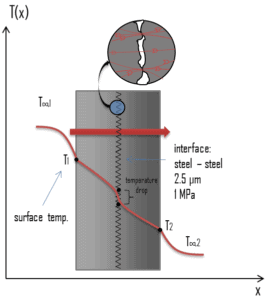
The usefulness of the analogy between the flow of electric current and the flow of heat becomes apparent when a satisfactory description of heat transfer at the interface of two conducting media is needed.
es: Resistencia de interfaz.
Plane wall conduction resistance.
Noun.
It is the thermal resistance of a medium that depends on the geometric configuration and the thermal properties of the medium.
es: Resistencia a la conducción en una pared plana.
Radiation resistance.
Noun.
It allows to express radiation in a convenient way, analogous to convection in terms of a temperature difference.
Example: A surface exposed to the surrounding air comprises convection and radiation simultaneously, thus determining the sum of radiation on it.
es: Resistencia a la radiación.
Sphere conduction resistance.
Noun.
In this case, the thermal resistance network consists of a conduction resistor and two convection resistors in series.
Example: In this case the net amount of heat entering the control volume by conduction in unit time and per unit volume.
es: Resistencia a la conducción de la esfera.
Surfaces.
Noun.
It is the limit of a continuous medium in contact with another medium with differentiated physical properties.
Example: The advantage of feedback quantum control is no requirement of a priori knowledge of the molecule's potential energy SURFACES.
es: Superficies.
Thermal contact conductance.
Noun.
In thermal engineering, the thermal contact conductance [W / m 2 .K] or the thermal contact resistance [m 2 .K / W] represents the conduction of heat between two solid bodies.
Example: The thermal contact conductance for aluminum plates with a surface roughness of 10 μm placed in air with an interface pressure of 1 atm is h c = 3640 W / m 2 .K
es: Conductancia térmica por contacto.
Thermal contact resistance.
Noun.
It is highly dependent on the roughness of the surface. It is observed that the thermal contact resistance decreases with decreasing surface roughness and increasing interface pressure.
Example: Thermal contact resistance can be minimized by applying a heat conductive liquid called thermal grease, such as CPU grease, to the surfaces before pressing together.
es: Resistencia térmica por contacto.
Total thermal resistance.
Noun.
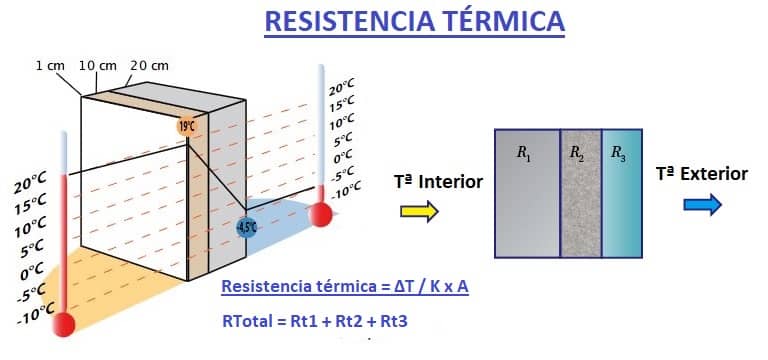
It is the sum of the surface resistances and the thermal resistance of the materials that make up the wall.
Example: Suppose we want to calculate the heat flux through a wall composed of 3 different materials, and we know the surface temperatures on each outer surface, TA and TB, and the properties and geometries of the materials, that is, their length and their area. The total thermal resistance would be the sum of each of the thermal resistances of each material, since they are considered to be in series, and this is the Rtotal in the case of the electrical one.